

How You Can Get Disability Benefits While Being Incarcerated
You can keep Social Security disability benefits during incarceration for up to 30 days.
However, payments usually stop after that unless your stay is brief or non-punitive and you meet medical criteria.
To restart benefits quickly after your release, it’s important to notify the SSA promptly and provide proof of your release.
Applying up to 120 days before leaving a Bureau of Prisons facility can help speed things up.
Additionally, staying on top of Medicare payments is key to ensuring you don’t run into issues later on.
There are helpful steps and resources you might want to contemplate next.
Eligibility Criteria for Disability Benefits During Incarceration
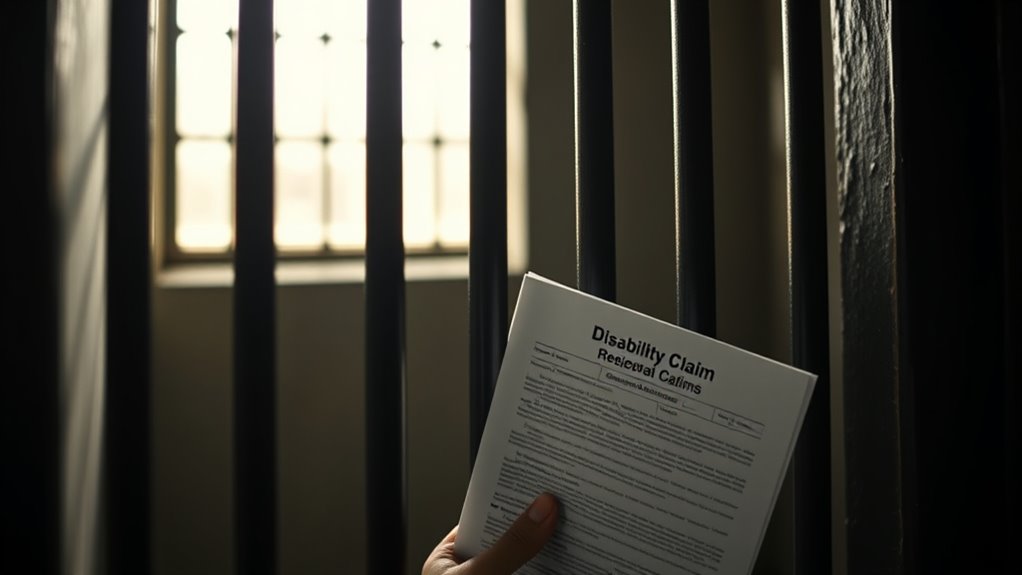
Although incarceration generally stops disability benefits after 30 days, you may still qualify if your confinement is brief or non-punitive.
Your eligibility for disability benefits during incarceration depends on meeting strict medical criteria and work history requirements, not on your guilt or innocence.
If you’re confined for less than a full calendar month or held under certain non-punitive conditions, you could maintain continued eligibility and keep receiving benefits.
However, once your incarceration exceeds 30 days, your benefits are suspended.
Don’t worry—these benefits can be reinstated upon your release, assuming you still meet all eligibility standards.
Understanding these rules helps you navigate how incarceration impacts your benefits and prepares you for a smooth transition when your status changes.
Impact of Incarceration on Social Security and SSI Payments
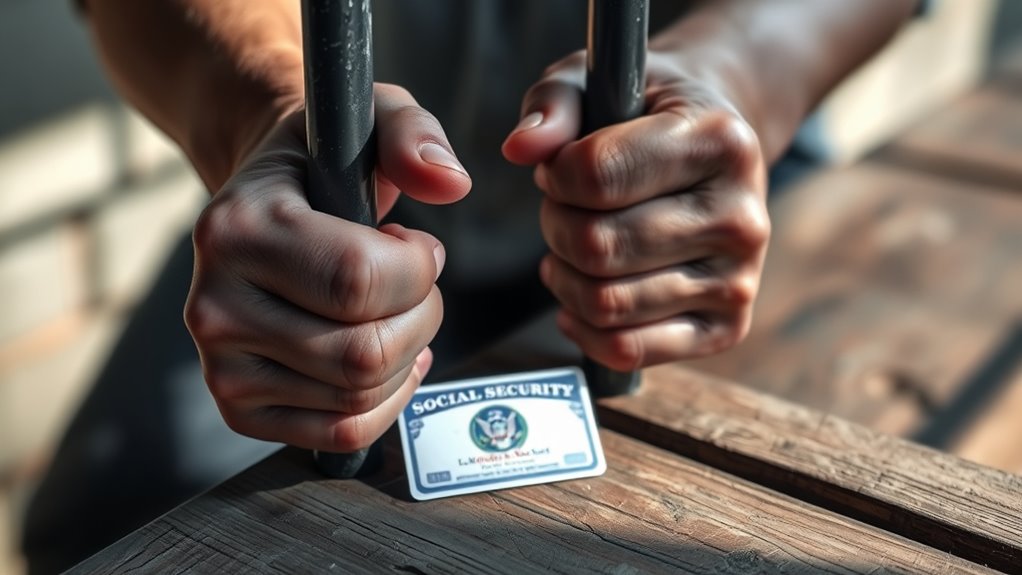
When you’re incarcerated for more than 30 consecutive days due to a criminal conviction, Social Security disability benefits will stop.
Payments will only cover the first 30 days. After that, benefits suspension kicks in, and your Social Security disability payments halt.
Social Security disability payments cover only the first 30 days before benefits suspension begins.
If you receive SSI, payments are suspended once you reside full-time in a public institution like a jail or prison.
You remain eligible for SSI only if incarceration lasts less than a full calendar month. Beyond that, SSI eligibility ends, and payments stop.
However, family members’ benefits based on your work record generally continue during your incarceration, provided they meet eligibility requirements.
Understanding how incarceration affects Social Security and SSI payments helps you navigate benefits suspension and plan accordingly during your time in a public institution.
Reporting Incarceration to Social Security Administration

You need to report your incarceration to the Social Security Administration promptly to prevent overpayments and guarantee your benefits are properly suspended.
You can notify SSA by contacting your local office or calling their toll-free number.
If you don’t report your status, you might face payment recovery or delays when your benefits restart after release.
Importance of Reporting
Why is it crucial to report your incarceration to the Social Security Administration (SSA) promptly?
Timely reporting helps prevent overpayment and ensures your disability benefits are adjusted correctly.
If you don’t inform the SSA, you risk overpayment recovery actions and potential legal issues.
Although SSA receives inmate data from correctional facilities, you should proactively report your incarceration and release to maintain eligibility and avoid delays in benefit adjustments.
| Action | Impact on Benefits | Consequence of Not Reporting |
|---|---|---|
| Reporting Incarceration | Benefits suspended | Overpayment risk, legal trouble |
| Reporting Release | Benefits resumed promptly | Delayed benefit restart |
| Failing to Report | Incorrect benefit status | Eligibility confusion |
Stay proactive with reporting to protect your disability benefits.
Reporting Procedures
Although correctional facilities usually report inmate status to the SSA, you should promptly notify the agency yourself when you become incarcerated.
Proper reporting helps prevent unnecessary overpayment recovery and ensures benefits suspension happens on time.
To manage your benefits effectively during incarceration, follow these steps:
- Report your incarceration to the Social Security Administration immediately to avoid complications with your benefits.
- Upon release, contact the SSA right away and provide official documentation of your release to facilitate benefit restart.
- Keep copies of all release documentation and correspondence with the SSA to support your case and prevent delays.
Consequences of Nonreporting
If you don’t report your incarceration to the SSA, your benefits may keep coming. This can create overpayments that you’ll have to repay later.
Nonreporting can cause payment errors since the SSA continues to send benefits despite your ineligibility during incarceration.
As a beneficiary, it’s your responsibility to notify the SSA promptly to trigger benefits suspension.
Failing to do so risks accumulating overpayments, which the SSA will demand back once discovered.
Beyond financial repercussions, nonreporting may lead to legal consequences, including penalties or accusations of fraud.
While correctional facilities may report your status, you must independently inform the SSA to ensure accurate benefit eligibility updates.
Proper reporting prevents unnecessary complications and helps suspend benefits during incarceration. This way, you can facilitate correct reinstatement when you’re released.
Don’t risk these avoidable issues—always report your incarceration on time.
Pre-Release Application Process for Disability Benefits
You can apply for disability benefits before your release, especially if you’re in a Bureau of Prisons facility, where applications can start up to 120 days in advance.
If you’re in another type of facility, the process usually begins when your release date is within 30 days, depending on how long disability decisions take.
Agreements between the SSA and correctional institutions can speed up processing.
But don’t worry—you can still submit your application early even without one to avoid delays.
Prerelease Application Eligibility
When you’re nearing release from a Bureau of Prisons facility, the Social Security Administration can start processing your disability benefits application up to 120 days in advance.
Your eligibility for a prerelease application depends on several factors related to your incarceration and release timeline. Here’s what you need to know:
- If you’re in a BOP facility, SSA begins pre-release processing up to 120 days before your release date.
- For non-BOP correctional facilities, SSA processes applications when release is within 30 days, based on disability determination timeframes.
- Some correctional facilities have prerelease agreements with SSA to expedite benefit reinstatement.
This ensures your social security disability benefits resume promptly after release.
Processing Timeframes and Agreements
Understanding how the Social Security Administration handles processing timeframes and agreements can help you better prepare for your disability benefits application before release.
If you’re eligible, SSA can begin SSI claim processing up to 120 days before your release date in federal prisons.
In non-BOP institutions, processing starts when release is expected within 30 days of the disability determination timeframe.
Pre-release agreements—either written or verbal—with correctional facilities allow SSA to start your prerelease application early.
This ensures SSI benefits resume immediately upon release.
Without these agreements, your benefits remain suspended until you contact SSA after release to submit your application.
Knowing your inmate eligibility and working with the facility on pre-release agreements can make a big difference in getting your benefits upon release without delay.
How to Restart Benefits After Release From Correctional Facilities
Although restarting your disability benefits after release from a correctional facility requires prompt action, you can simplify the process by contacting the Social Security Administration immediately and providing proof of your release.
Restart your disability benefits quickly by promptly contacting the SSA and submitting proof of release.
To guarantee a smooth benefits restart, follow these steps:
- Submit your release documentation and updated personal information to SSA to meet eligibility criteria for benefit reinstatement.
- Provide proof of release, like official papers, and any required identification promptly to avoid delays.
- Stay in regular contact with SSA to confirm your benefits have been reinstated and address any additional requests.
Managing Medicare Coverage While Incarcerated
Because Medicare Part B requires monthly premium payments to stay active, you’ll need to manage these payments carefully while incarcerated to avoid losing your medical coverage.
Medicare Part A continues automatically during incarceration, but unpaid Part B premiums can cause coverage lapses, leaving you vulnerable to unexpected medical bills.
If your coverage ends, you can re-enroll during the general enrollment period or a special enrollment period after your release.
Staying on top of your premiums prevents gaps in coverage and ensures your healthcare needs are met once you’re out.
| Concern | Impact | Action Needed |
|---|---|---|
| Unpaid premiums | Coverage lapses | Pay premiums monthly |
| Coverage lapses | Medical bills | Reenroll promptly |
| Incarceration | Part A continues | Monitor Part B status |
| Missed enrollment | Delay in coverage | Use special enrollment |
| Medical bills | Financial burden | Maintain coverage |
Resources and Support for Justice-Involved Individuals
If you’re approaching release from a correctional facility, you can start applying for disability benefits up to 120 days in advance through the SSA.
This helps facilitate a smooth transition and quicker access to your Social Security benefits.
Here are key resources and support options to consider:
- SSA agreements with some prisons notify them of your release, speeding up benefit reinstatement.
- After release, promptly provide proof to SSA for immediate reinstatement of your disability benefits.
- Explore veteran-specific programs if you receive VA disability benefits, as incarceration may affect those.
Understanding your eligibility and connecting with these support systems can minimize gaps in benefits during and after incarceration.
This support will help you regain financial stability quickly once you’re out.
Frequently Asked Questions
Can You Collect Disability if You’re Incarcerated?
You can’t collect disability benefits if you’re incarcerated for over 30 consecutive days.
However, if your stay is shorter or you’re not convicted, benefits might continue.
Always report your status to the SSA to avoid issues.
What to Say to Get Approved for Disability?
You’ll want to clearly explain your medical conditions, symptoms, and how they stop you from working.
Include detailed medical records, doctor’s statements, and honestly describe how your disability impacts daily life to strengthen your approval chances.
Does Disability Pay More Than Social Security?
Disability definitely delivers more dollars than Social Security’s Supplemental Security Income.
Because SSDI depends on your work history, it typically tops the modest, means-tested SSI, giving you greater gains and guaranteed growth based on your earnings.
What Is the One Time Emergency Payment for SSDI?
The one-time emergency payment for SSDI is a lump sum given to you during urgent hardships like disasters or medical emergencies.
You need to apply and prove your situation to receive this temporary financial help from the SSA.
It’s important to be prepared and understand the requirements for the application.
This can provide some relief when you need it the most.
Conclusion
Think of your journey through incarceration like traversing a dense forest.
Though the path seems blocked, disability benefits are like a hidden compass guiding you toward financial stability.
By understanding eligibility, reporting your status, and planning ahead, you can uncover this support even behind bars.
When you’re ready to leave, these benefits help clear the way for a fresh start.
Stay informed, and let this compass lead you through the toughest terrain to a brighter future.
In conclusion, navigating the complexities of disability benefits while incarcerated may feel overwhelming.
However, by knowing your rights and the necessary steps to take, you can find the support you need.
Those benefits can provide crucial financial assistance upon your release, allowing for a smoother transition back into society.
Keep the focus on understanding eligibility and staying informed to ensure you’re prepared for a brighter future ahead.