

Does Facet Arthropathy Qualify as a Disability?
If your facet arthropathy leads to ongoing pain, restricted mobility, or nerve-related issues lasting over a year, you may be eligible for disability benefits.
It’s essential to have medical documentation, such as imaging results and statements from your doctor, to demonstrate how your condition affects your daily activities and work capabilities.
To strengthen your case, you should aim to meet specific criteria outlined in the SSA Blue Book or show equivalent functional loss.
This approach will significantly enhance your chances of approval.
Keep reading to learn how to gather the necessary evidence and navigate the application process effectively.
Understanding Facet Arthropathy and Its Symptoms
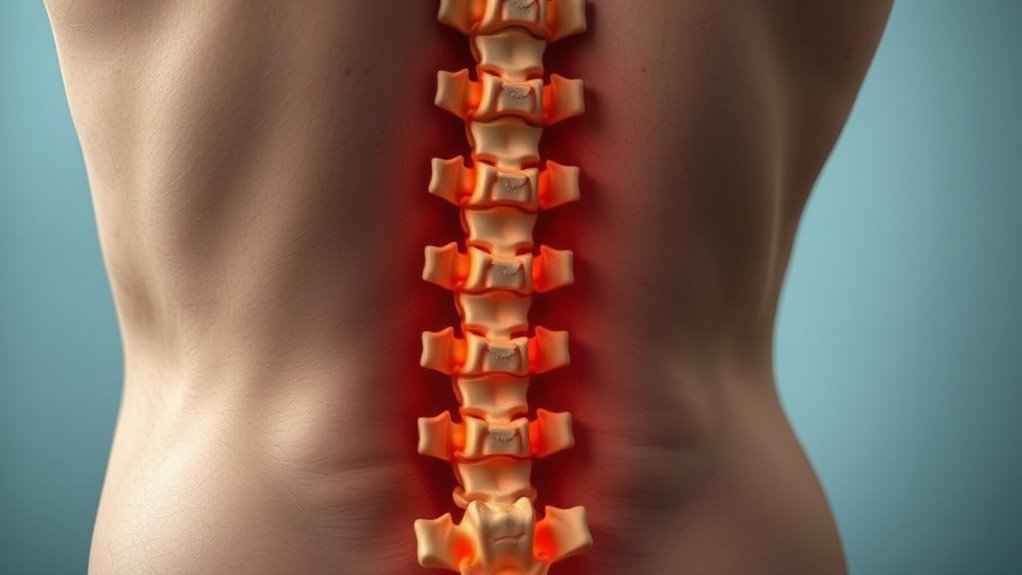
Although you might not realize it at first, facet arthropathy affects the small joints between your spine’s vertebrae, causing pain and stiffness.
This degenerative joint condition often leads to back pain and muscle spasms that worsen with activity or prolonged sitting.
You might notice pain radiate to your shoulders, head, legs, or buttocks depending on the spinal area involved.
Facet arthropathy can limit your range of motion, making everyday movements difficult and leading to postural changes like a hunched posture.
These symptoms contribute to limited mobility and discomfort.
To confirm the diagnosis, your doctor will likely use diagnostic imaging to assess the extent of joint degeneration and spinal condition.
Understanding these symptoms helps you recognize the impact of facet arthropathy on your daily life.
Criteria for Disability Qualification With Facet Arthropathy

Living with facet arthropathy means dealing with pain and limited mobility that can interfere with your ability to work.
To achieve disability qualification, you must meet SSA criteria showing severity symptoms and functional limitations. Here’s what’s essential:
- Provide medical evidence proving persistent pain, limited mobility, or nerve impingement lasting 12+ months.
- Show medical documentation matching SSA Blue Book spinal disorders listings, like nerve root compromise or spinal stenosis.
- Demonstrate symptoms such as muscle weakness or sensory deficits that impair your ability to perform substantial gainful activity.
- If you don’t meet exact listings, prove ongoing functional limitations under a symptom-based or medical equivalence approach.
Meeting these criteria strengthens your case for disability benefits due to facet arthropathy’s impact on your daily life.
Medical Evidence Needed to Support a Disability Claim

When you apply for disability due to facet arthropathy, gathering thorough medical evidence is essential to support your claim.
This includes detailed medical documentation from your treating physicians that confirms the diagnosis through clinical assessments and diagnostic imaging like X-rays, MRIs, or CT scans showing joint degeneration or nerve impingement.
Your treatment history—covering medications, injections, physical therapy, or surgeries—helps demonstrate the severity of symptoms and their persistence.
Physician statements and medical source opinions should clearly explain how your condition limits your physical abilities and daily functioning.
Consistent medical evidence over time, documenting ongoing symptoms and treatment, strengthens your claim by providing a clear picture of your condition’s impact.
Without this comprehensive medical evidence, proving disability due to facet arthropathy becomes challenging.
The Process of Applying for Disability Benefits
Since proving disability due to facet arthropathy requires solid medical evidence, you’ll need to gather all relevant documentation before applying for benefits.
The SSA evaluates your disability claim by reviewing your medical records and treatment history to determine if your condition prevents substantial gainful activity.
Here’s what you should focus on during the application process:
- Collect extensive medical evidence, including imaging and physician statements.
- Submit your application online, by phone, or in person.
- Prepare for possible reconsideration and hearings if initially denied.
- Understand your right to appeal within 60 days and consider legal assistance if needed.
Following these steps ensures your disability benefits claim is thorough and stands the best chance of approval.
Legal Assistance for Facet Arthropathy Disability Claims
Guiding the disability benefits process for facet arthropathy can feel overwhelming, especially if your initial claim gets denied.
A disability attorney provides essential legal assistance by gathering and organizing medical evidence and documentation that clearly demonstrates your condition’s impact.
They carefully review your insurance coverage and eligibility criteria to guarantee your disability claim meets all requirements.
If your claim faces denial, your attorney will manage the appeals process, filing necessary paperwork and communicating directly with the insurer to protect your rights.
This expert support increases your chances of claim approval and helps you navigate complex procedures efficiently.
Frequently Asked Questions
Can I Get Disability for Facet Arthropathy?
Yes, you can get disability for facet arthropathy if your symptoms severely limit your ability to work.
You’ll need strong medical evidence, imaging, treatment records, and a professional evaluation confirming your functional limitations.
It’s important to gather all the necessary documentation to support your claim.
This will help demonstrate how facet arthropathy impacts your daily life and work capacity.
Is Facet Arthropathy Serious?
Imagine you struggle to walk due to sharp back pain and stiff joints—yes, facet arthropathy is serious.
It can cause intense pain, limit your movement, and markedly disrupt your daily life if left untreated.
This condition isn’t something to take lightly.
If you’re experiencing these symptoms, it’s important to seek help.
What Spinal Conditions Automatically Qualify for Disability?
Spinal stenosis, nerve root compression, arachnoiditis, and advanced degenerative disc disease automatically qualify if you meet strict criteria like documented nerve damage and limited spine motion.
However, facet arthropathy alone usually doesn’t qualify automatically.
It’s important to understand the specifics of each condition and the necessary documentation needed for qualification.
What Kind of Doctor Should I See for Facet Arthropathy?
You should see a spine specialist like an orthopedic surgeon or neurosurgeon for facet arthropathy.
They’ll diagnose and treat your condition.
Pain management doctors and rheumatologists can also help with symptoms and underlying issues.
Conclusion
If you think facet arthropathy is just a minor ache, think again—it can turn your life upside down!
You don’t have to suffer in silence or struggle alone.
With the right medical proof and a solid claim, you could access disability benefits that change everything.
Don’t let paperwork or confusion bury your chances.
Step up, get help, and fight for what you deserve—because your pain is real, and your rights are even realer!
Facet arthropathy can significantly impact your daily life and ability to work.
If you believe your condition qualifies as a disability, it’s essential to gather medical documentation and seek expert assistance.
Remember, you’re not alone in this fight for disability benefits.
Stand up for yourself and ensure you receive the support you need.
Your pain matters, and so do your rights!