How to Be a Content Creator While on Disability Step by Step
Creating content while on disability can be a fulfilling endeavor that allows you to express yourself and connect with others.
Before you dive in, it’s crucial to understand your benefits and work incentives, such as the Trial Work Period and Substantial Gainful Activity limits.
This knowledge will help you navigate the balance between earning an income and maintaining your benefits.
Next, choose a niche that resonates with you and select platforms that support accessibility features like captions and screen readers.
This ensures that your content is inclusive and reaches a wider audience.
Always report your earnings promptly to the SSA to safeguard your benefits.
Using accessible tools can make your content creation process easier and more manageable.
Don’t forget to balance your work with your benefits and connect with supportive communities for guidance.
Keep pushing forward to explore effective strategies and legal tips that can enhance your journey as a content creator on disability.
Understanding Disability Benefits and Work Incentives

While managing disability benefits can feel complex, understanding how work incentives like the Trial Work Period (TWP) and Extended Period of Eligibility (EPE) function will help you create content without risking your SSDI benefits.
You get nine months under the TWP where any earnings count as a trial month, letting you test your work capacity.
The Trial Work Period offers nine months where all earnings qualify, allowing you to safely test your ability to work.
After that, the EPE gives you a 36-month window to keep receiving benefits as long as your monthly income stays below the Substantial Gainful Activity (SGA) limit—$1,690 in 2026.
It’s essential you report all your work activities and earnings to SSA to stay compliant.
These work incentives ensure you can explore content creation while safeguarding your benefits and avoiding overpayments.
Choosing Your Content Creation Niche

How do you pick a content creation niche that fits both your passions and your disability?
Start by choosing a niche that aligns with your interests and strengths. This will help keep your content authentic and motivating.
Make sure the niche allows for flexible work. You can incorporate tools like text-to-speech or closed captions to ensure your content is accessible.
Research gaps in popular topics to help raise awareness and offer unique value. This way, you won’t overextend yourself while creating meaningful content.
Consider the self-employment income potential too. It’s important to understand how it fits with Social Security laws and work incentives, ensuring your income security.
Begin with manageable content to build your confidence and develop resilience.
The right platform will help you create web pages and videos that support people with disabilities.
If you’re looking for advice, it simply means choosing a niche that suits you and your health while planning a successful career.
Selecting Accessible Platforms and Tools
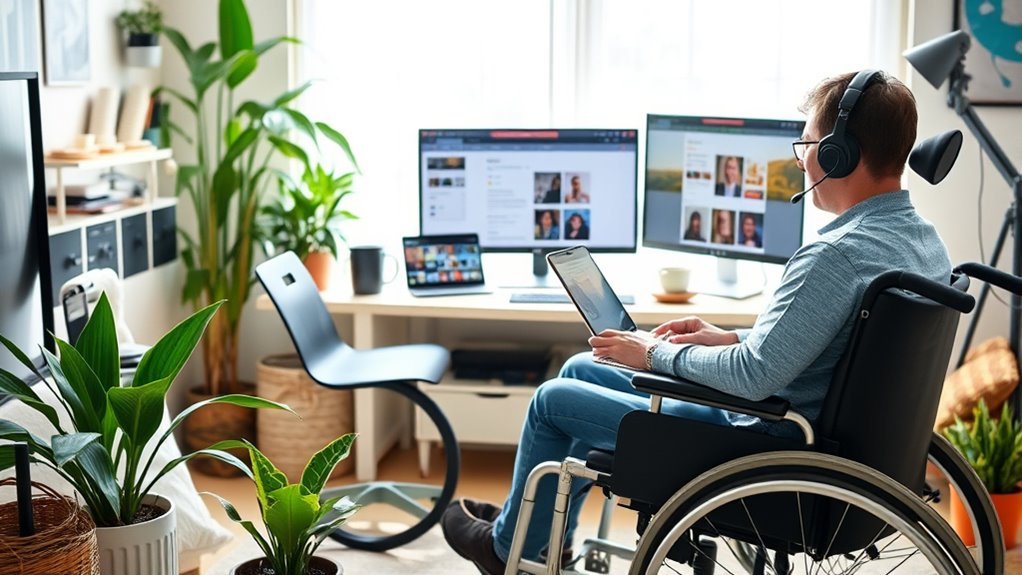
You’ll want to pick platforms like YouTube or Instagram that offer built-in accessibility features such as captions and screen reader support.
Make sure your tools let you add captions, transcripts, or audio descriptions to keep your content inclusive.
Checking that everything meets accessibility standards will help you reach and engage a wider audience effectively.
Platform Accessibility Features
Because accessible platforms and tools form the foundation of inclusive content creation, choosing ones that support features like automatic captions, alt text, and screen reader compatibility is essential.
Platforms such as YouTube, Facebook, and Instagram offer built-in accessibility options, including video transcripts, closed captioning, and keyboard navigation.
You should also make certain your content creation tools support accessible formats like adjustable text sizes and audio descriptions.
Verify that your chosen platform complies with WCAG guidelines and legal standards such as ADA and Section 508 to maximize accessibility.
Regularly updating your content using platform accessibility analytics and user feedback helps improve reach and user experience for viewers with disabilities.
Prioritizing these features ensures your content is inclusive and accessible to everyone.
Tool Compatibility Considerations
When selecting platforms and tools for content creation, prioritize those that work seamlessly with assistive technologies like screen readers, voice commands, and magnifiers.
This guarantees you can navigate and create without barriers.
Check if your tools support captioning, keyboard navigation, and speech-to-text features.
Also, consider platforms that perform well on low bandwidth or mobile devices to fit your internet and hardware needs.
Before committing, review user feedback and official accessibility documents to confirm true compatibility.
Feel empowered using tools designed with your needs in mind.
Stay connected despite internet or device limits.
Create confidently knowing accessibility features support you.
Join a community that values and respects your abilities.
Inclusive Content Creation
Selecting accessible platforms and tools plays a crucial role in inclusive content creation.
You should choose platforms like YouTube, Facebook, and Instagram that support captions, transcripts, and screen reader compatibility.
Use design tools such as Canva or Adobe Creative Cloud, which offer accessible templates to make your visual content inclusive.
Prioritize formats that adapt well—videos with captions and descriptions, blog posts with alt text, and podcasts with transcripts ensure everyone can engage with your content.
Don’t forget accessible hardware like ergonomic microphones and adjustable lighting to enhance quality for diverse audiences.
Ultimately, regularly check platform accessibility guidelines and updates.
Staying informed helps you keep your content compliant and reach the broadest possible audience while respecting accessibility needs.
Creating Inclusive and Accessible Content
When you create content, making it accessible guarantees everyone can enjoy and engage with your work.
Using tools like alt text, captions, and high-contrast designs helps you reach a wider audience and meet important guidelines.
Prioritizing accessibility not only benefits your viewers but also strengthens your impact as a creator.
Accessibility Basics Overview
Creating accessible content guarantees that everyone, including people with visual, auditory, or cognitive impairments, can engage with your work effectively.
By following accessibility basics, you not only meet legal standards like WCAG levels A, AA, and AAA but also make your content welcoming and easy to use for all.
Simple steps like adding alternative text for images, captions for videos, audio descriptions, and transcripts can transform your content’s reach and impact.
You’ll build a more inclusive community and showcase your commitment to social responsibility.
Consider this:
- Your content becomes a bridge, not a barrier, to connection.
- People feel seen and valued when you accommodate their needs.
- Accessibility boosts your confidence as a creator who cares.
- Every effort you make creates ripples of positive change.
Tools for Inclusion
Making your content accessible starts with the right tools that help you design and share inclusive material.
Start by adding alt text to images and graphics, so screen readers can describe visual content. Use captions, transcripts, and audio descriptions for videos to make sure everyone can access your message.
Follow WCAG guidelines to guarantee your content is easy to navigate and use for people with different disabilities. Leverage accessible design tools and plugins available on platforms like YouTube and Adobe to enhance inclusivity.
Don’t forget to regularly test your content with accessibility evaluation tools such as PowerMapper or WAVE. These tools help you identify and fix barriers, making your content truly welcoming to all audiences.
Benefits of Accessibility
Although it may seem challenging at first, ensuring your content is accessible opens the door to over a billion people worldwide who have disabilities.
By adding captions, alt text, and transcripts, you make your content usable in noisy settings and for those with hearing or vision impairments.
Accessibility also protects you from legal risks and shows you care about diversity and equal access. Plus, it improves user experience, engagement, and SEO.
When you create accessible content, you empower a diverse community to connect with your message.
You also demonstrate respect and inclusivity that builds trust.
Additionally, you avoid legal complications by meeting standards like ADA and WCAG while enhancing your brand’s reputation as socially responsible.
Making accessibility a priority benefits both your audience and your growth as a creator.
Managing Earnings and Reporting to SSA
When you start earning income from content creation while on disability, it’s vital to report all your earnings to the Social Security Administration (SSA) promptly.
During your Trial Work Period (TWP), any amount you earn counts as a trial month. You have up to nine months to test your work without losing benefits.
After the TWP, your benefits continue only if your monthly earnings stay below the Substantial Gainful Activity (SGA) limit, which is $1,690 for non-blind individuals in 2026.
Keep detailed records of your income, expenses, and work activity to support accurate reporting during SSA reviews.
Monitoring your earnings closely is essential because exceeding the SGA threshold can lead to suspension or termination of your disability benefits.
Building and Engaging Your Audience
To grow your community, focus on sharing content that feels genuine and invites conversation.
Respond to comments and create opportunities for your audience to participate, like live streams or Q&A sessions.
This active engagement helps build a loyal following that supports and interacts with your work.
Growing Your Community
Building and engaging your audience starts with consistently sharing authentic content that reflects your disability experience.
To grow your community, focus on creating meaningful connections by responding to comments and hosting live sessions.
Collaborate with other creators in the disability space to reach new viewers and build supportive networks.
Make your content accessible with captions and detailed descriptions to welcome everyone.
Keep an eye on your engagement stats and feedback to fine-tune what you share, ensuring it resonates deeply.
Try these to evoke emotion in your audience:
- Share personal stories that highlight challenges and triumphs.
- Show behind-the-scenes moments of your creative process.
- Celebrate small victories and growth milestones.
- Create content that inspires hope and resilience.
Encouraging Active Participation
Although creating authentic content lays the foundation, encouraging your audience to actively participate transforms your community into a vibrant, supportive space.
Consistently share content that reflects your disability experience to connect deeply with your viewers.
Engage directly by responding to comments, hosting live streams, and staying active on social media.
Use accessibility features like captions and descriptions to make your content inclusive, reaching a wider audience.
Openly share your journey and challenges to inspire meaningful conversations around disability.
Regularly analyze your content’s performance to see what resonates most and adjust your posts accordingly.
Overcoming Challenges as a Disabled Creator
When you navigate content creation while on disability, managing your income carefully becomes essential to maintain your benefits.
You’ll need to track and report your earnings precisely to stay within SSA limits. Understanding the Trial Work Period and Extended Period of Eligibility can help you earn without risking your SSDI benefits.
Using accessible tools reduces strain and makes creating easier. Proper documentation of hours, earnings, and expenses will keep you compliant and supported.
Don’t hesitate to seek guidance from disability or small business support groups—they offer valuable strategies tailored to your needs.
Balancing work and benefits feels like walking a tightrope.
Finding accessible tools empowers your creativity.
Keeping detailed records builds your confidence.
Connecting with support networks sustains your motivation.
Legal and Financial Considerations for Creators
Managing your income carefully is just one part of staying on track as a content creator receiving disability benefits.
If you’re on SSDI, remember the Substantial Gainful Activity limit lets you earn up to $1,690 per month in 2026 without losing benefits.
During your Trial Work Period, all earnings count but won’t affect benefits for nine months—giving you a chance to test working.
For SSI, income reduces benefits after the first $65, so track earnings precisely.
Always report income and work activity promptly to the SSA and IRS to avoid overpayments or penalties.
To protect yourself legally and gain tax advantages, consider forming an LLC or other small business entity.
Taking these steps helps you balance creativity, income, and benefits responsibly.
Leveraging Community and Networking Opportunities
Since building connections can greatly boost your growth as a content creator on disability, tapping into communities and networks is essential.
Engage with disability-focused groups like the Disability Visibility Project to find support and collaboration.
Join local or virtual advocacy groups to amplify your message and promote your content.
Collaborate with fellow disabled creators on platforms such as YouTube or TikTok to expand your audience.
Attend industry conferences or webinars focused on accessibility to gain valuable contacts and knowledge.
Feel empowered by sharing your story with those who truly understand.
Discover opportunities through supportive, like-minded networks.
Experience the strength of collaboration in raising awareness.
Grow your platform with connections that celebrate your unique voice.
Utilizing Resources for Disabled Content Creators
Although maneuvering content creation with a disability can present challenges, you don’t have to do it alone.
Numerous organizations and online communities offer tailored resources and support to help you succeed.
Groups like the Disability Visibility Project and Ability Online provide valuable guidance and community.
The Job Accommodation Network (JAN) can help you find adaptive tools and workplace accommodations.
Connect with disability-focused Facebook groups or Reddit forums to gain advice and collaboration opportunities.
You can also tap into resources from the Small Business Administration (SBA) and local vocational rehabilitation agencies for funding, training, and legal support.
Plus, platforms like YouTube and TikTok offer accessibility features and creator programs designed to empower disabled content creators.
Use these resources to build your skills and grow your audience confidently.
Frequently Asked Questions
How Do I Start Being a Content Creator?
Start by choosing a niche you love.
Then set up simple recording gear like your smartphone.
Create accounts on social platforms,
plan content that fits your schedule,
and post consistently to build your audience.
What Is the Hardest Disability to Prove?
The hardest disabilities to prove are often mental health conditions like depression or anxiety since you can’t see them.
They rely on subjective symptoms, making it tough to provide clear, objective medical evidence for approval.
Can You Make Passive Income While on Disability?
You can grow passive income like a steady garden while on disability,
but you’ve got to tend it carefully.
Keep earnings within limits and consult experts to guarantee your benefits don’t wither away unexpectedly.
Who Is the Famous Disabled Influencer?
You probably know Tatiana Maslany, Molly Burke, Lizzie Velasquez, Aimee Mullins, and Chrissy Metz—they’re famous disabled influencers who inspire millions by sharing their stories and advocating for disability representation and empowerment.
Each one of them brings a unique perspective and experience to the table.
Their voices help shine a light on the importance of inclusion and the power of resilience.
Conclusion
So, ready to conquer the content world without losing your disability benefits or your sanity?
Just remember: juggling creativity, accessibility, and paperwork is your new extreme sport.
But hey, who needs a circus when you’ve got Social Security, niche brainstorming, and endless community support cheering you on?
Keep hustling, keep creating, and maybe—just maybe—you’ll become the next big thing your mom brags about at family dinners.
You’ve got this, superstar!
—
In conclusion, stepping into the content creation scene while on disability is entirely possible.
With the right balance of creativity, organization, and support, you can thrive without jeopardizing your benefits.
Embrace your unique perspective and use it to connect with others.
Remember, your journey can inspire others who are navigating similar paths.
So, keep pushing forward, and who knows? You might just be the next content sensation everyone talks about!