
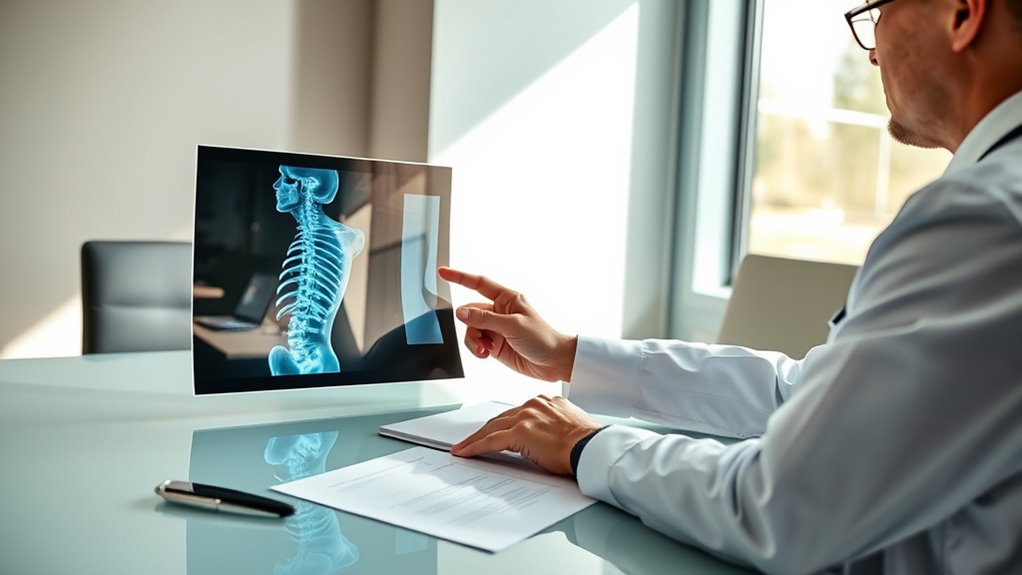
How Can You Get Disability for Scoliosis?
You can get disability for scoliosis if it severely limits your ability to work and perform daily activities for at least 12 months.
To qualify, you’ll need thorough medical evidence, such as X-rays and doctor notes, that demonstrate chronic pain, restricted movement, or respiratory issues caused by your spinal curvature.
Meeting Social Security’s criteria can significantly increase your chances of approval.
Additionally, seeking legal assistance can further boost your odds of a successful claim.
Keep exploring to understand how to strengthen your claim and navigate the process effectively.
Understanding the Different Types of Scoliosis
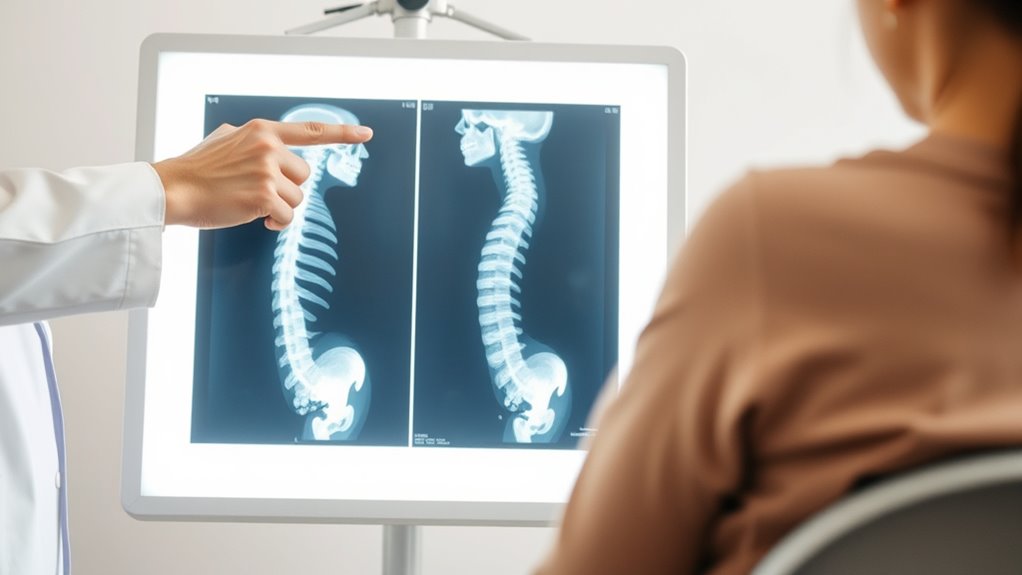
Although scoliosis may seem like a single condition, it actually includes several types that differ based on their causes.
Scoliosis encompasses various types, each defined by distinct underlying causes and characteristics.
When you learn about the types of scoliosis, you’ll understand why treatment and disability qualification vary.
Idiopathic scoliosis, the most common, affects about 80% of cases and usually develops during puberty without a known cause.
Congenital scoliosis results from spinal curvature caused by vertebral malformations present at birth, often diagnosed early.
Neuromuscular scoliosis happens secondary to conditions like cerebral palsy or muscular dystrophy, linked to nerve or muscle issues.
Degenerative scoliosis develops gradually as you age due to wear and tear on discs and joints between vertebrae.
Recognizing these types helps you grasp how scoliosis impacts your body and disability considerations.
Recognizing Symptoms That Impact Daily Life

You might notice common scoliosis symptoms like back pain, muscle weakness, or difficulty sitting for long periods affecting your daily routine.
These physical limitations can make tasks at work or home more challenging.
Recognizing how these symptoms impact your daily life is key to managing your condition effectively.
Common Scoliosis Symptoms
How can you tell if scoliosis is affecting your daily life?
Look for common scoliosis symptoms like uneven shoulders, waist, or hips, and visible spinal curvature.
You might also notice back pain, muscle stiffness, or neurological symptoms such as tingling if nerves are compressed.
In severe cases, respiratory issues may arise due to chest compression.
These symptoms can cause physical limitations and worsen over time, impacting your mobility and musculoskeletal health.
| Symptom Category | Examples | Impact on Daily Life |
|---|---|---|
| Spinal Curvature | Visible curve, uneven hips | Posture, balance |
| Back Pain | Muscle stiffness, soreness | Movement, activity endurance |
| Neurological Symptoms | Nerve pain, tingling | Sensation, coordination |
| Respiratory Issues | Shortness of breath | Physical exertion |
| Physical Limitations | Reduced mobility | Daily tasks, independence |
Daily Life Challenges
Recognizing scoliosis symptoms is just the start; understanding how they affect your daily life reveals the real challenges you face.
Chronic pain and muscle weakness can make even simple daily activities feel exhausting. Mobility limitations may force you to rely on mobility aids or require frequent repositioning.
Respiratory issues might cause fatigue or shortness of breath, further complicating routine tasks.
Here are some daily life challenges you might encounter:
- Struggling to sit or stand for long periods without discomfort.
- Difficulty performing household chores or work duties.
- Needing mobility aids to move safely and comfortably.
- Experiencing fatigue due to respiratory or cardiovascular strain.
These functional impairments markedly impact your independence and quality of life.
It really highlights the seriousness of scoliosis beyond visible symptoms.
Physical Limitations Explained
Although scoliosis symptoms vary, chronic pain and muscle weakness often limit your ability to perform everyday tasks.
Spinal limitations and mobility issues can make sitting, standing, bending, or lifting difficult, causing significant physical impairment.
These functional limitations affect your work and daily routines, reducing endurance and increasing discomfort.
Severe scoliosis may also cause breathing or heart problems, further restricting your physical capacity.
To qualify for disability benefits, you need medical evidence documenting these symptoms of scoliosis and their impact on your daily life.
Recognizing how these physical limitations hinder your ability to function helps strengthen your claim.
Understanding the severity of your spinal condition and its effect on mobility is vital in demonstrating the true extent of your disability.
When Is Scoliosis Considered a Disability?
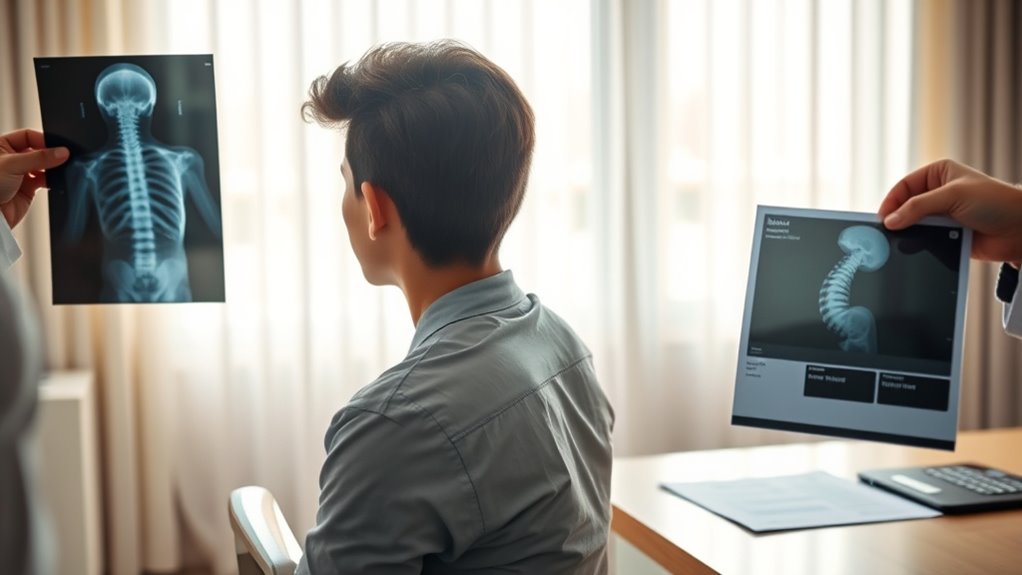
Because scoliosis can vary widely in severity, it’s considered a disability only when it causes significant symptoms that limit your daily activities and ability to work for at least a year.
To qualify for benefits, your scoliosis disability must show a high severity level supported by medical evidence documenting functional limitations.
Even if scoliosis isn’t explicitly listed in the SSA Blue Book, it can qualify based on its impact on your work ability.
Key factors include:
- Persistent pain or muscle weakness
- Nerve root compression causing neurological symptoms
- Limited spinal motion affecting mobility
- Respiratory or cardiovascular issues linked to spinal deformity
Showing these impairments with thorough medical evidence helps establish when scoliosis qualifies as a disability.
Social Security’s Criteria for Disability Due to Scoliosis
While the SSA doesn’t list scoliosis specifically, it evaluates your condition under spinal disorders to determine disability eligibility.
To qualify for disability benefits, your scoliosis must cause significant functional limitations, such as nerve root compression, restricted spinal motion, or motor and sensory loss.
The SSA relies heavily on medical evidence—like X-rays, MRIs, and detailed physician reports—to assess the severity and impact of your scoliosis.
Chronic pain, difficulty sitting or standing, and related respiratory or cardiac issues can also support your claim.
Your impairment must meet or equal a listing in the Blue Book and be expected to last at least 12 months or result in death.
Meeting these criteria helps the SSA decide if your scoliosis qualifies you for disability benefits.
Medical Documentation Needed for a Successful Claim
To build a strong disability claim for scoliosis, you’ll need thorough medical documentation that clearly shows the severity and impact of your condition.
Your medical reports should include:
- Diagnostic imaging like X-rays or MRIs confirming the curvature and any nerve root compression.
- Detailed physician notes describing your impairment, treatment history, and daily limitations.
- Records of ongoing or past treatments—braces, physical therapy, or surgeries—to prove chronicity.
- Evidence that your condition or symptoms have lasted or are expected to last at least 12 months.
This medical documentation helps demonstrate how scoliosis affects your ability to work and perform daily activities, strengthening your claim for disability benefits.
How Residual Functional Capacity Affects Eligibility
Your Residual Functional Capacity (RFC) shows how scoliosis limits your ability to perform physical tasks like standing, sitting, or lifting.
This assessment directly impacts whether you can do your past work or any other job.
To support your claim, you’ll need strong medical evidence that clearly details these limitations.
Assessing Physical Limitations
Since scoliosis affects how you perform everyday physical tasks, evaluating your Residual Functional Capacity (RFC) is key to determining disability eligibility.
RFC measures how scoliosis limits your ability to do physical activities essential for work.
The Social Security Administration (SSA) guidelines consider a 20% or more productivity loss significant.
To assess this, medical evidence like doctor reports, X-rays, and MRI scans play a vital role.
Your physical limitations might include:
- Difficulty bending or twisting
- Needing frequent position changes
- Inability to lift or carry certain weights
- Reduced stamina for standing or walking
This thorough RFC evaluation helps establish if your scoliosis substantially impacts your ability to work.
If it does, you may qualify for disability benefits under SSA rules.
Impact on Work Tasks
Understanding how your Residual Functional Capacity (RFC) limits your ability to perform work tasks is key to proving disability eligibility.
With scoliosis, your RFC measures how physical limitations like difficulty standing, sitting, walking, or lifting affect your job performance.
If you can’t lift more than 10 pounds or bend beyond 45 degrees, these restrictions reduce your ability to maintain work.
The SSA evaluates whether your scoliosis-related limitations prevent sustained employment for at least 12 months.
To qualify for disability benefits, you need medical evidence detailing how scoliosis impacts your daily activities and work tasks.
Your healthcare provider’s RFC report outlines specific restrictions, forming the basis for your disability claim.
Demonstrating these impacts clearly strengthens your case with the SSA and increases your chances of receiving benefits.
Medical Evidence Importance
Although proving disability for scoliosis hinges on your Residual Functional Capacity (RFC), medical evidence plays a crucial role in accurately defining those limitations.
To strengthen your claim for disability benefits, you need detailed medical records documenting how scoliosis affects your daily function. This includes MRI scans and doctor’s notes illustrating:
- Restrictions on sitting, standing, walking, or bending
- Difficulty lifting or carrying objects
- Frequency and severity of pain or discomfort
- Any functional impairments limiting work-related activities
The Social Security Administration relies heavily on this medical evidence to assess your RFC and determine eligibility.
Without detailed documentation, it’s tough to prove how scoliosis restricts your ability to work.
Navigating the Social Security Disability Insurance (SSDI) Process
When you apply for SSDI due to scoliosis, you’ll need to prove that your condition substantially limits your ability to work for at least 12 months.
The Social Security Administration (SSA) reviews your medical evidence and evaluates your residual functional capacity to see how spinal impairments affect your work capabilities.
Since scoliosis isn’t explicitly listed in the Blue Book, you must show related spinal impairments or complications that qualify you for disability benefits.
Gathering detailed doctor reports, X-rays, and MRI scans is vital to support your claim.
Managing the application process can be complicated, so working with a disability lawyer or advocate can help guarantee your documentation is thorough.
This support can also increase your chances of approval for Social Security disability benefits.
Exploring Supplemental Security Income (SSI) for Scoliosis
If your scoliosis severely limits your ability to work and you have limited income and assets, you may qualify for Supplemental Security Income (SSI).
To establish eligibility for disability benefits through SSI, you’ll need to:
- Show your scoliosis impairment causes significant functional limitations lasting at least 12 months.
- Provide strong medical evidence like X-rays, MRIs, and doctor’s reports documenting your condition.
- Meet or medically equal the Social Security medical listing for scoliosis or demonstrate comparable disability through a medical-vocational assessment.
- Submit detailed financial information proving your limited income and assets.
Qualifying for SSI might also grant you Medicaid, helping cover scoliosis-related treatments.
Focus on gathering thorough medical evidence and understanding how your functional limitations match SSI’s medical listing to improve your chances of eligibility.
Common Challenges in Securing Disability Benefits
Securing disability benefits for scoliosis can be challenging because many claims get denied initially.
This often happens due to insufficient medical evidence or failure to clearly show how the condition limits your ability to work.
When you file disability claims, you must provide thorough medical documentation that details your functional limitations and meets the SSA criteria.
Without all-encompassing evidence proving your scoliosis substantially impairs your ability to perform work-related activities for at least 12 months, your application likely won’t meet the criteria for scoliosis.
Many applicants struggle to understand these SSA criteria, which complicates the process and reduces the chances of disability approval.
To improve your odds, you need to clearly document your symptoms, treatment history, and how scoliosis affects your daily functioning.
Make sure your medical evidence aligns with SSA requirements.
The Role of Legal Assistance in Disability Claims
Although maneuvering the disability claims process can feel overwhelming, having legal assistance can considerably improve your chances of approval.
A skilled attorney helps you by gathering and presenting medical evidence that clearly shows how scoliosis limits your work ability.
They also navigate the complex SSA application and ensure all paperwork aligns with federal requirements.
Additionally, they identify qualification pathways under the SSA’s Blue Book or medical-vocational allowances specific to scoliosis.
If your initial disability claims are denied, they can handle any appeals for you.
Legal assistance increases your likelihood of success—claimants with attorneys are three times more likely to receive benefits.
Many firms, like Bross & Frankel, PA, offer free consultations to evaluate your case and build a strong claim.
Frequently Asked Questions
How to Get on Disability With Scoliosis?
You’ll need to prove your scoliosis severely limits your ability to work by submitting medical records, imaging, and doctor notes.
Make sure you detail your symptoms.
Consider hiring a disability lawyer to strengthen your claim.
Can You Get 100% Disability for Scoliosis?
Like a mountain blocking your path, you can get 100% disability for scoliosis if it severely limits your daily life or work.
You’ll need strong medical evidence showing chronic pain, nerve issues, or breathing problems.
It’s important to document everything thoroughly to support your claim.
Don’t hesitate to seek help from medical professionals who understand your condition.
Is Scoliosis Counted as a Disability?
Scoliosis can count as a disability if it severely limits your daily activities or work ability.
Mild cases usually don’t qualify, but if your condition causes significant pain or mobility issues, you may be eligible for benefits.
What Spinal Conditions Automatically Qualify for Disability?
When it comes to spinal conditions, you’ll find severe scoliosis with nerve compression, spinal stenosis, herniated discs, and spinal cord injuries automatically qualify for disability.
They’re the cream of the crop for SSA approval.
Conclusion
Securing disability for scoliosis can seem challenging, but staying steadfast and savvy makes a significant difference.
By understanding symptoms, supplying solid medical evidence, and smoothly managing Social Security’s system, you set yourself up for success.
Don’t dismiss the daunting details—dedicated legal help can dramatically drive your claim forward.
Stay strong, stay smart, and steadily endeavor for the support you deserve.
In conclusion, getting disability for scoliosis involves a clear understanding of your condition and the necessary documentation.
Having solid medical proof and navigating the Social Security system can be complex, but it’s crucial.
Don’t hesitate to seek legal assistance; it can greatly enhance your chances of a successful claim.
Your journey may be tough, but with determination and the right support, you can transform your challenge into a story of strength and stability.