

Is Spinal Stenosis a Permanent Disability and How to Apply for Benefits
If your spinal stenosis leads to lasting nerve damage and significantly restricts your ability to work full-time, it may qualify as a permanent disability according to Social Security regulations.
To support your claim, you’ll need solid medical evidence, such as MRI scans and doctor notes that document nerve compression and your functional limitations.
The application process involves gathering detailed medical records and completing the necessary forms.
You might also consider seeking assistance for appeals if your initial application is denied.
It’s essential to keep exploring the specific medical criteria, required paperwork, and the steps you need to take to enhance your chances of approval.
Understanding Spinal Stenosis and Its Impact on Daily Life

Although spinal stenosis primarily affects people over 50, you can experience symptoms that substantially disrupt your daily life at any age.
This condition causes nerve compression due to the narrowing of your spinal canal. As a result, you may face chronic pain, numbness, and weakness.
These symptoms often impair your mobility, making routine tasks and daily functioning challenging.
You might find walking difficult or experience leg cramps and balance issues that limit your independence.
If your functional limitations are severe, spinal stenosis can be considered a disability.
To pursue Social Security benefits, it’s vital to gather thorough medical documentation detailing your symptoms and how they affect your ability to work and perform daily activities.
Understanding these impacts helps you advocate effectively for the support you need.
Medical Criteria for Disability Qualification Under SSA Guidelines

When you apply for disability benefits due to spinal stenosis, the Social Security Administration (SSA) requires clear medical evidence showing how your condition impairs your nervous system.
For disability qualification under SSA guidelines, you must demonstrate neurological impairments caused by the narrowing of the spine.
Imaging studies like MRI or CT scans need to confirm spinal canal or foramina narrowing consistent with your symptoms.
Imaging such as MRI or CT scans must verify spinal narrowing that matches your reported symptoms.
Physical examination must reveal signs such as muscle weakness, sensory deficits, reduced reflexes, or pain limiting your mobility.
Your condition must cause functional limitations preventing sustained full-time work and last at least 12 months to qualify as a permanent disability.
Meeting these medical criteria with objective evidence is essential for your spinal stenosis disability claim under SSA guidelines.
Essential Medical Documentation for Spinal Stenosis Disability Claims
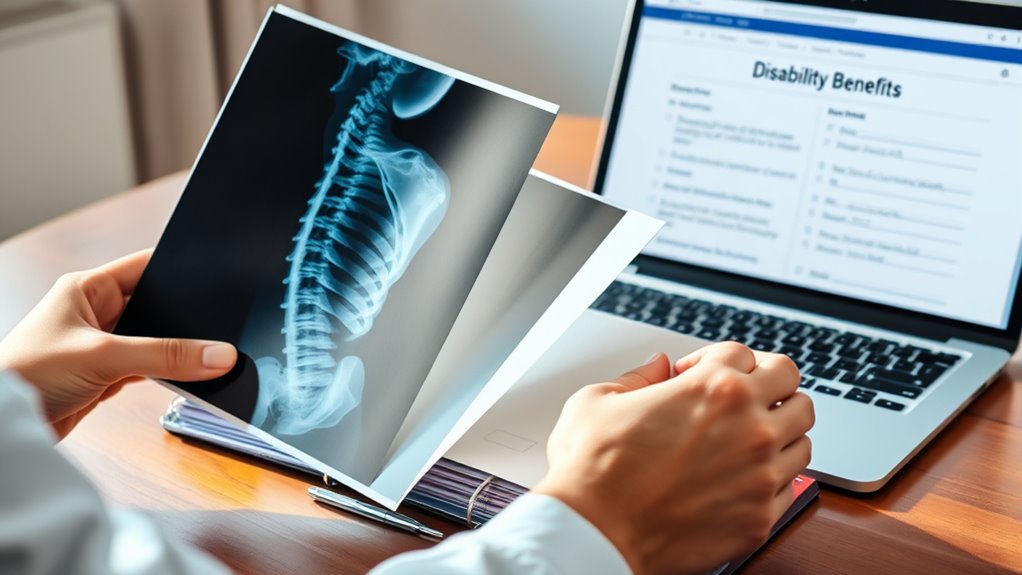
To build a strong spinal stenosis disability claim, you’ll need thorough medical documentation that clearly shows how your condition affects your daily life and work capacity.
Focus on gathering:
- Detailed imaging reports (MRI or CT scans) proving spinal canal narrowing and nerve impingement with numerical evidence.
- Physical exam records documenting neurological deficits like weakness, sensory loss, reduced reflexes, and limited motion.
- Extensive treatment history covering pain management, medications, surgeries, and physical therapy.
- Objective evidence of functional restrictions, including mobility aids use and notes on bowel/bladder issues.
This medical documentation must explicitly link symptoms to your inability to perform routine tasks or maintain employment.
Navigating VA Disability Ratings for Lumbar and Cervical Stenosis
Gathering detailed medical evidence sets the stage for understanding how the VA assigns disability ratings for lumbar and cervical stenosis.
Detailed medical evidence is essential for understanding VA disability ratings for lumbar and cervical stenosis.
VA disability ratings range from 10% to 100%, based on the severity of your symptoms and limitations, as outlined in the VA Schedule for Rating Disabilities.
Key factors include nerve impingement, radiculopathy, and how stenosis impacts your mobility and daily activities.
Your medical evidence—like MRI results and doctor’s notes on mobility restrictions and use of assistive devices—directly influences your rating.
The VA carefully evaluates pain levels, muscle weakness, and sensory deficits to determine if your condition qualifies as a permanent disability.
Providing accurate, thorough documentation increases your chances of receiving the appropriate disability benefits for both lumbar stenosis and cervical stenosis.
Steps to Apply for Social Security Disability Benefits Due to Spinal Stenosis
If your spinal stenosis substantially limits your ability to work, applying for Social Security Disability benefits requires careful preparation and detailed medical evidence.
To navigate the application process effectively, follow these steps:
- Gather thorough medical evidence, including MRI or CT scans and detailed medical records documenting your functional limitations.
- Complete the Social Security disability application online, by phone, or in person. Make sure to clearly explain how symptoms like pain and numbness impair your work capacity.
- Ensure your medical records include doctors’ assessments of your restrictions related to walking, standing, and mobility.
- Consult a disability lawyer to help document your impairments and assist with appeals if your initial disability determination is denied.
This approach strengthens your claim and improves your chances to qualify for benefits based on spinal stenosis.
Frequently Asked Questions
Is It Hard to Get Disability for Spinal Stenosis?
Yes, it’s often hard to get disability for spinal stenosis because you need extensive medical proof showing severe limitations lasting at least a year.
Working with a skilled attorney and detailed records boosts your chances considerably.
How Much Money Can You Get for Spinal Stenosis?
You can get around $1,558 monthly on average from SSDI for spinal stenosis, but it varies based on your work history.
SSI averages about $943, and veterans’ benefits depend on service connection and severity.
How Much Does SSDI Pay for Spinal Stenosis?
If life slows you down, SSDI can offer around $1,558 monthly on average for spinal stenosis.
But with severe cases and a strong work history, you might receive up to $3,822.
Your earnings shape your benefit.
Is Spinal Stenosis a Long-Term Disability?
Yes, spinal stenosis can be a long-term disability if your symptoms persist and substantially limit your daily activities.
You’ll need medical evidence showing ongoing impairment to qualify for disability benefits.
Keep tracking your symptoms closely.
Conclusion
You might worry that spinal stenosis isn’t severe enough to qualify for disability benefits, but if it considerably limits your daily activities or work, you have a strong case.
Remember, the key is thorough medical documentation and understanding SSA or VA criteria.
By following the right steps and providing clear evidence, you can successfully apply for the benefits you deserve.
It’s important to focus on how spinal stenosis impacts your life.
This includes detailing your symptoms and how they restrict your ability to perform daily tasks or maintain employment.
With well-organized medical records and a solid understanding of the application process, you can navigate the system more easily.
In conclusion, spinal stenosis can be a valid reason to seek disability benefits.
Ensure you provide comprehensive documentation and demonstrate how it affects your quality of life.
With the right approach, you can achieve the support you need to enhance your well-being.